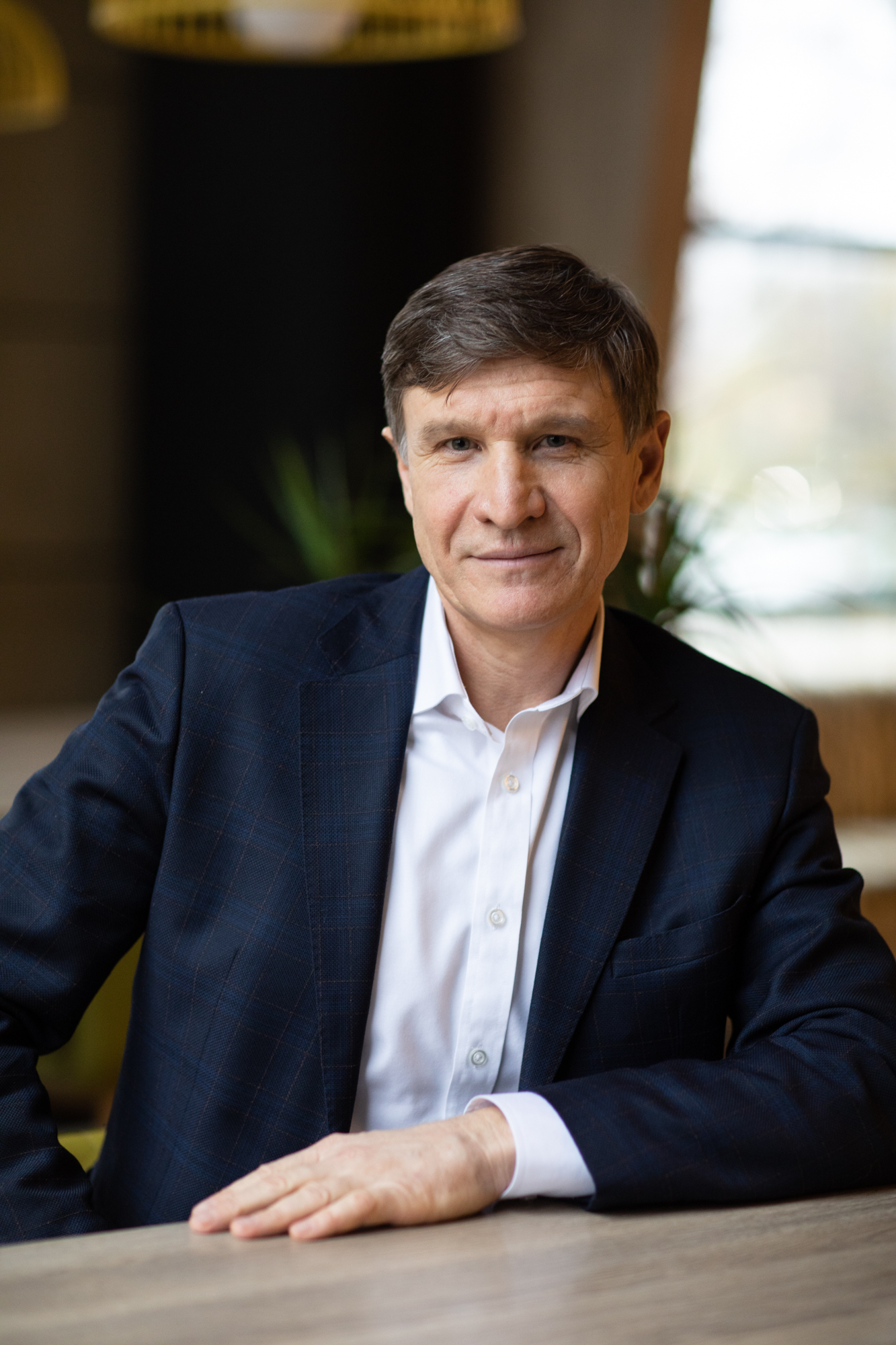

Oleg Jermilov - International Alumni
Oleg Jermilov
Amid the historic turning points of the late 1980s, Oleg Jermilov arrived in Hungary. Today, more than three decades later, he still lives here and is considered one of the key figures in the Hungarian tourism sector. The story of the former scholarship student is both personal and historical: it reflects the tensions surrounding the collapse of the Soviet Union, the atmosphere of Hungary’s political transition, and the journey of a young man searching for his place in a completely new world.
A Scholarship Driven by a Thirst for Adventure
Oleg first came to Hungary in August 1989 as a scholarship student. The scholarship program was established following the 1983 university visit of Mikhail Gorbachev, who at the time served as a secretary of state. The essence of the program was that the best students from agricultural universities of the Soviet Union could apply, after completing their first year, to study at the Gödöllő University of Agricultural Sciences. During the first two years, instruction was conducted in Russian, while students simultaneously attended intensive Hungarian language courses in preparation for the following three years, which they completed entirely in Hungarian.
According to Oleg, this scholarship represented an enormous opportunity at the time. At Saratov University, six students in his cohort graduated with excellent results, but only two of them undertook studies abroad. The others considered Hungary—regarded as “the end of the world”—too distant and too uncertain. For Oleg, however, a sense of adventure outweighed all other concerns.
University Years, Friends, and Community
The dormitory system deliberately mixed Hungarian and foreign students. According to Oleg, this greatly helped them to learn the language quickly and to build genuine relationships.
The community of Soviet students was multinational: young people arrived from Russia, Ukraine, the Baltic states, the Caucasus—virtually every republic.
Relations between Hungarian and foreign students were particularly good. Oleg does not recall any conflicts or exclusion; in his view, shared living, socializing, and studying together felt completely natural. Although his connections with Hungarian classmates faded in later years, he has remained closely tied to the Russian-speaking friends who stayed in Hungary. The regular Friday football matches that began during their university years continued to keep the group together for more than fifteen years after graduation.
Life After Graduation – Entrepreneurship in the Turmoil of the Political Transition
Oleg graduated in 1994 with a degree in business organization. Although he had originally planned to become an agronomist, after completing the general studies he turned toward economics. Returning home at that time, however, would have been extremely uncertain: due to the collapse of the Soviet Union, the economic breakdown, rampant inflation, and disrupted supply chains—“everything was grinding to a halt from one day to the next,” as he puts it.
By then, however, he had already started a family in Hungary. He met his wife here—she was also a Russian citizen studying at the Pető Institute—and he increasingly oriented his life toward staying in the country. In the first half of the 1990s, he ventured into various businesses: car imports, exporting canned food to Russia—“I tried everything,” he says.
The turning point came in 2001, when he – together with his best friend and university fellow Alexander Baranov – realized that the Hungarian–Russian tourism market had a future, even though few people were working in this field at the time. This led to the founding of the 1000 Út Travel Agency, which today employs 35 people, offers tours to all over the world and also operates a four-star hotel.
From the early 2000s onward, the growing travel demands of the Russian middle class gave tremendous momentum to the business. Incoming tourism increased year by year, strengthening the agency in parallel. Oleg is particularly proud that he remains actively involved in supporting the next generation of professionals: he regularly hosts interns, gives lectures, and enjoys collaborating with higher education institutions.
The Most Beautiful Memories – The Beginning of a True Friendship and Love Story
When asked which moment from his university years he remembers most fondly, he did not hesitate: “When I met my wife.”
It is worth noting that very few women studied at the Faculty of Agriculture, so among the Soviet male students it was considered a real sensation if someone found a partner. At the Pető Institute, however, the ratio was quite the opposite: many more women arrived there from abroad. Friendships and relationships between students of the two institutions led to many love stories—including Oleg’s.
The other most important relationship in Oleg's life, his best friend, who was mentioned several times during the conversation and with whom he had an extremely close relationship—not only as a friend but also as a business partner—until his relatively early death, is also connected to the university.
The story of Oleg Jermilov is not only the life path of a former university student, but also a reflection of an era. It is the story of a young man who arrived in Hungary amid the storms of political transition, found his family, his vocation, and his place here—and who today is himself part of the history written over recent decades by the community of international students who studied in Gödöllő.